
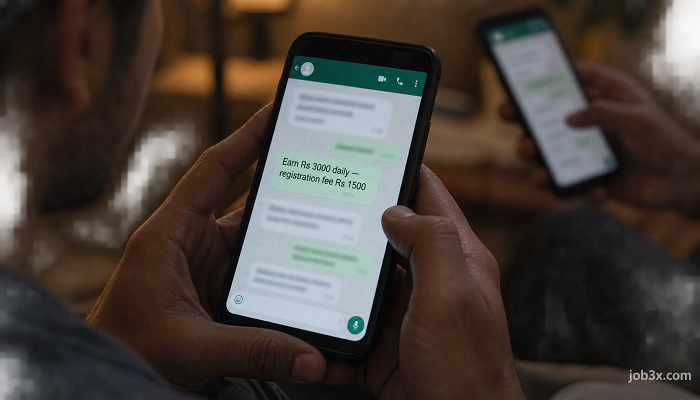
Last month a cousin forwarded me a screenshot. A “company” was offering Rs 3,000 a day for liking YouTube videos. Registration fee: Rs 1,500. He asked me if it was real.
I told him to send the Rs 1,500 to me instead. At least he’d get a free lesson out of it.
He laughed. A few hundred other people in that group probably didn’t.
The pattern is always the same
These offers never fail on the marketing. They fail on the maths.
Think about what they’re asking you to do: click a button, like a post, watch a video. If it was worth Rs 3,000 a day, the company would have built a script that does it automatically in five minutes. They wouldn’t need you. They wouldn’t need a thousand of you.
The money isn’t coming from the work. It’s coming from the next person who pays the registration fee.
Five things I look for now
1. You have to pay first.
Real work pays you. It does not charge you. There is no legitimate freelancing platform where you deposit money to start receiving tasks. Fiverr doesn’t ask. Upwork doesn’t ask. A real employer doesn’t ask you to pay for “account activation” or “training material.”
The moment money moves from your pocket to theirs before any work happens, stop.
2. They only exist on WhatsApp or Telegram.
A real company has an address, a name registered somewhere, and a website older than two weeks. If the only way to reach them is an admin who replies at 2 AM from a Pakistani number, there is no company.
3. The group has been running for nine days.
Check the group creation date. Scam groups are built, milked, and abandoned in under a month. When people start asking for withdrawals, the group disappears and a new one opens with the same admin and a new name.
4. Withdrawals are always “processing.”
This is the stage that hurts. In the beginning, small withdrawals actually get paid — Rs 500, Rs 1,000. That’s not generosity. That’s bait. It buys your trust, and it makes you tell five friends.
Then you bring in more money, and every withdrawal goes to “processing.” The admin stops replying. The group goes quiet.
5. The earnings make no sense.
A task that takes one minute pays Rs 50. That’s Rs 3,000 an hour. Now ask: what company on earth pays an unskilled, unverified, anonymous person Rs 3,000 an hour to tap a screen?
If the number sounds too good, it’s because the number is the product. It’s there to make you ignore the fee.
What actually works instead
I’m not going to pretend online earning in Pakistan is easy. It isn’t. The things that pay real money are boring:
- A skill someone will pay for — writing, editing, design, basic bookkeeping, voice-over, simple web fixes
- A platform that doesn’t charge to start — Fiverr, Upwork, and local job boards
- Three to six months of being bad at it before anyone pays you properly
That’s the honest version. It doesn’t make a good WhatsApp forward, which is exactly why nobody forwards it.
One question that saves everything
Before joining anything, ask: “Who is paying, and for what?”
If the only answer is “new members,” you’re not the worker. You’re the product.
Send this to the person who forwards you these offers. Not to argue with them — just so that when the group dies in three weeks, they remember someone told them.